


Baldwin-Lomax model
From CFD-Wiki
The Baldwin-Lomax model is a two-layer algebraic model which gives the eddy-viscosity,  , as a function of the local boundary layer velocity profile.
|
| (1) |
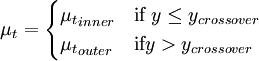
Where  is the smallest distance from the surface where
  is equal to
  :
:
|
| (2) |

The inner region is given by the Prandtl - Van Driest formula:
|
| (3) |

Where
|
| (4) |
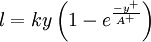
|
| (5) |
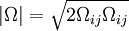
|
| (6) |
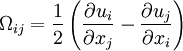
The outer region is given by:
|
| (7) |

Where
|
| (8) |

 and
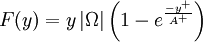
and  are determined from the maximum of the function:
|
| (9) |
 is the intermittency factor given by:
|
| (10) |
![F_{KLEB}(y) = \left[1 + 5.5 \left( \frac{y \, C_{KLEB}}{y_{MAX}} \right)^6
\right]^{-1}](/W/images/math/9/b/d/9bde77641b7e232fa3e083d3e59795c4.png)
 is the difference between maximum and minimum speed in the profile. For boundary layers the minimum is always set to zero.
|
| (11) |

Model constants
The table below gives the model constants present in the formulas above. Note that  is a constant, and not the turbulence energy, as in other sections. It should also be pointed out that when using the Baldwin-Lomax model the turbulence energy, , present in the governing equations, is set to zero.
 |
 |
 |
 |
|
 |
| 26 | 1.6 | 0.3 | 0.25 | 0.4 | 0.0168 |
References
- "Thin Layer Approximation and Algebraic Model for Separated Turbulent Flows" by B. S. Baldwin and H. Lomax, AIAA Paper 78-257, 1978

