


Realisable k-epsilon model
From CFD-Wiki
(Difference between revisions)
| (2 intermediate revisions not shown) | |||
| Line 1: | Line 1: | ||
| + | {{Turbulence modeling}} | ||
== Transport Equations == | == Transport Equations == | ||
| Line 23: | Line 24: | ||
where <math> \overline{\Omega_{ij}} </math> is the mean rate-of-rotation tensor viewed in a rotating reference frame with the angular velocity <math> \omega_k </math>. The model constants <math> A_0 </math> and <math> A_s </math> are given by: <br> | where <math> \overline{\Omega_{ij}} </math> is the mean rate-of-rotation tensor viewed in a rotating reference frame with the angular velocity <math> \omega_k </math>. The model constants <math> A_0 </math> and <math> A_s </math> are given by: <br> | ||
| - | <math> A_0 = 4.04, \; \; A_s = \sqrt{6} \cos \phi </math> | + | <math> A_0 = 4.04, \; \; A_s = \sqrt{6} \cos \phi </math> <br> |
| + | |||
| + | <math> \phi = \frac{1}{3} \cos^{-1} (\sqrt{6} W), \; \; W = \frac{S_{ij} S_{jk} S_{ki}}{{\tilde{S}} ^3}, \; \; \tilde{S} = \sqrt{S_{ij} S_{ij}}, \; \; S_{ij} = \frac{1}{2}\left(\frac{\partial u_j}{\partial x_i} + \frac{\partial u_i}{\partial x_j} \right) </math> | ||
| + | |||
| + | |||
| + | ==Model Constants == | ||
| + | |||
| + | <math> C_{1 \epsilon} = 1.44, \;\; C_2 = 1.9, \;\; \sigma_k = 1.0, \;\; \sigma_{\epsilon} = 1.2 </math> | ||
| + | |||
| + | [[Category:Turbulence models]] | ||
Revision as of 09:24, 12 June 2007
 model
model
 model
model
Transport Equations
![\frac{\partial}{\partial t} (\rho k) + \frac{\partial}{\partial x_j} (\rho k u_j) = \frac{\partial}{\partial x_j} \left [ \left(\mu + \frac{\mu_t}{\sigma_k}\right) \frac{\partial k} {\partial x_j} \right ] + P_k + P_b - \rho \epsilon - Y_M + S_k](/W/images/math/0/0/4/004f9597d5f640c6152d7ee7ec2af16a.png)
![\frac{\partial}{\partial t} (\rho \epsilon) + \frac{\partial}{\partial x_j} (\rho \epsilon u_j) = \frac{\partial}{\partial x_j} \left[ \left(\mu + \frac{\mu_t}{\sigma_{\epsilon}}\right) \frac{\partial \epsilon}{\partial x_j} \right ] + \rho \, C_1 S \epsilon - \rho \, C_2 \frac{{\epsilon}^2} {k + \sqrt{\nu \epsilon}} + C_{1 \epsilon}\frac{\epsilon}{k} C_{3 \epsilon} P_b + S_{\epsilon}](/W/images/math/9/e/1/9e195cf17f086a6a1ad3914571b491ba.png)
Where
![C_1 = \max\left[0.43, \frac{\eta}{\eta + 5}\right] , \;\;\;\;\; \eta = S \frac{k}{\epsilon}, \;\;\;\;\; S =\sqrt{2 S_{ij} S_{ij}}](/W/images/math/1/9/3/193f62d995a6b0190d41325b612bf336.png)
In these equations,  represents the generation of turbulence kinetic energy due to the mean velocity gradients, calculated in same manner as standard k-epsilon model.
  is the generation of turbulence kinetic energy due to buoyancy, calculated in same way as standard k-epsilon model.
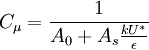
Modelling Turbulent Viscosity

where
 ;
;
 ;
;

where  is the mean rate-of-rotation tensor viewed in a rotating reference frame with the angular velocity
  . The model constants
  and
and  are given by:


Model Constants


